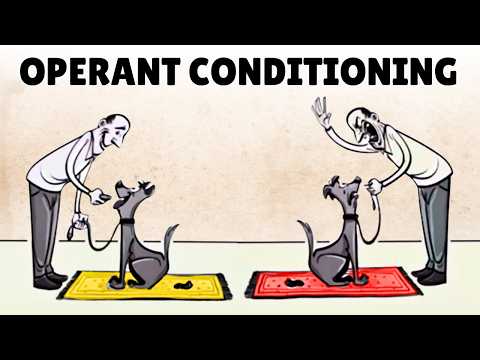
Alright, let’s talk about something cool: operant conditioning. Sounds fancy, but stick with me; it’s really just a way we learn through rewards and punishments.
You know how when you do something good, like finishing a project early, and someone gives you a high-five? That little boost feels great, right? That’s operant conditioning in action!
It’s all about how our behavior changes based on what happens afterward. You do something, and then you get either a treat or a “nope.” Simple as that!
This idea has shaped not just our understanding of learning but also how we approach things like training pets or even managing our own habits. Seriously, the way we learn is everywhere—like that time you kept hitting snooze until your alarm turned off completely.
Ready to dig deeper? Let’s see how this little concept plays such a big role in our lives!
Understanding Skinner’s Theory of Operant Conditioning: Key Concepts and Applications in Psychology
Operant conditioning is one of those classic psychology concepts that pops up a lot when you’re diving into learning theories. You’ve probably heard of B.F. Skinner, the guy behind it, right? Well, he had some pretty interesting ideas on how behavior is influenced by consequences. Let’s break it down!
So, what is operant conditioning? Basically, it’s a learning process where behaviors are shaped by rewards or punishments. If you do something and get a positive result, you’re likely to do it again. On the flipside, if it leads to something unpleasant, you might avoid that behavior in the future.
Key Concepts:
- Reinforcement: This strengthens a behavior. There are two types:
- Positive reinforcement adds something nice. Like when your kid cleans their room and you give them praise or a treat.
- Negative reinforcement: This takes away something unpleasant. Imagine your alarm goes off for a morning meeting; turning it off is great because now the annoying sound is gone!
- Punishment: This decreases a behavior:
- Positive punishment: Here’s where you add something unpleasant. Think about getting extra chores for not doing your homework.
- Negative punishment: This involves taking away something good. Like losing video game time because of bad grades.
- Schedules of Reinforcement: How often or when rewards are given plays a big role in how well behaviors are learned.
- Fixed-ratio schedule: You get a reward after a set number of responses—like getting paid after every ten tasks done.
- Variable-ratio schedule: Here, it’s more unpredictable—like gambling where the win may come after an unknown number of tries.
- Aversive Conditioning: This uses unpleasant stimuli to stop unwanted behaviors. Like using bad-tasting medicine to help someone stop biting their nails.
- Extinction: It’s what happens when reinforcement stops and the behavior fades away over time—like when kids stop cleaning their rooms if they don’t get praised anymore!
Applications in Psychology: The beauty of operant conditioning is that it can be applied in various fields! In education, teachers often use these principles to encourage learning through incentives like gold stars or extra recess time.
It also shows up in therapy settings! Behavior modification techniques can help people change habits or manage conditions like anxiety or depression. For instance, therapists might use token economies where patients earn tokens for positive behaviors that can be exchanged for fun activities.
So yeah, Skinner’s theory isn’t just some dusty old concept locked away in textbooks; it’s alive and kicking in everyday life! Understanding this stuff helps us see how our actions are shaped by what happens afterward—and that’s pretty powerful knowledge!
Exploring the Impact of Pavlov and Skinner on the Evolution of Psychology
Pavlov and Skinner are like the rock stars of psychology. Their work laid the foundation for how we understand learning and behavior. Seriously, if you’re talking about psychology, you’ve got to mention them!
Ivan Pavlov is most famous for his experiments with dogs. Yeah, you heard that right. He discovered classical conditioning pretty much by accident while studying digestion. What he did was ring a bell before feeding the dogs, and they started to salivate just at the sound of it. Can you imagine? The bell wasn’t food; it was just a sound! That showed that our brains can learn to associate different stimuli with certain outcomes.
Then you’ve got B.F. Skinner, who took things a step further with his work on operant conditioning. Now this guy was super interested in how consequences shape behavior. His experiments with rats and pigeons were pretty famous too. Skinner created something called a “Skinner box” where he could reward animals for certain behaviors, like pressing a lever for food. Basically, if the behavior gets rewarded, they’re likely to do it more often. It’s like when you give your buddy high-fives whenever they make you laugh—before long, they’re cracking jokes just to get that sweet high-five!
In terms of psychological learning, both classical and operant conditioning have had a massive impact on therapy practices today. For instance, let’s say someone is afraid of dogs because they had a bad experience once—this fear can be tackled using principles from Pavlov’s work by gradually introducing them to friendly dogs in safe environments until they feel more comfortable.
Skinner’s ideas are also huge in education and behavior management strategies—you know those reward charts teachers use? That’s operant conditioning at play! When kids see their good behavior rewarded—like extra playtime—they’re more likely to keep it up.
So basically, both Pavlov’s and Skinner’s research changed how we view learning and behavior entirely. They showed us that whether it’s an automatic response or something shaped by rewards and punishments, there’s so much going on in our minds when we learn new things or change behaviors.
To wrap it up:
- Pavlov: Introduced classical conditioning through his infamous dog experiments.
- Skinner: Developed operant conditioning by using rewards and punishments.
- Both have influenced therapy methods and educational practices.
Their influence on psychology is still strong today; it shapes everything from classroom management techniques to therapeutic approaches for anxiety disorders! So next time you think about learning something new—or helping someone else learn—consider these two pioneers who helped us understand what really makes minds tick!
Understanding Operant Conditioning: Its Impact on Psychological Learning Explained
Operant conditioning is one of those concepts that can really change how you think about learning and behavior. Basically, it’s all about how consequences shape our actions, you know? If you get rewarded or punished for something, it can seriously influence whether you’ll do it again. This idea comes from a psychologist named B.F. Skinner, who had some pretty interesting views on behavior.
So let’s break this down a bit. Operant conditioning involves reinforcements and punishments. Reinforcement increases the chances that a behavior will happen again, while punishment decreases the likelihood of that behavior repeating itself. Think of it this way: when your dog sits on command and gets a treat, they’re likely to sit again because it was reinforced with something positive.
Now let’s touch on the different types of reinforcement. You’ve got positive reinforcement, which is like giving a reward for good behavior—like when you study hard and ace an exam! Then there’s negative reinforcement. This doesn’t mean punishment; it means taking something bad away to encourage a good action. For example, if you clean your room to avoid getting nagged by your parents, well, you’re experiencing negative reinforcement.
Then there’s punishment. There are two types here too: positive and negative punishment. Positive punishment adds something unpleasant to discourage a behavior (like getting scolded for being late), while negative punishment takes something enjoyable away (like losing TV time for not doing chores). I remember once when I left my bike unlocked outside my friend’s house and it got stolen—that was a harsh lesson in making sure to secure my stuff!
This whole system plays out in lots of areas beyond just training pets or kids. Think about school settings where teachers use praise or detention as tools for managing student behavior. If students know they’ll get rewarded for participating in class but face consequences for disruptive behavior, they’re more likely to engage appropriately.
You might be wondering how this all ties into psychological learning overall. Well, operant conditioning helps us understand not just why we behave the way we do but also how habits form over time. Our environments are constantly shaping our actions through various forms of feedback based on what follows our behaviors.
In sum, operant conditioning shows how consequences play a crucial role in shaping behaviors—and this is huge in both personal growth and societal norms! It explains everything from why we might stick with certain routines to how institutions manage behaviors collectively.
So next time you’re trying to change a habit or teach someone something new—remember that rewards and consequences can be powerful tools! They’re more than just concepts; they’re at play in daily life more often than we realize.
Operant conditioning, huh? It’s one of those terms that sounds super fancy, but once you get into it, it’s really just about how we learn from the stuff that happens around us. Basically, it’s like this: you do something, and based on what happens next—good or bad—you either keep doing it or you steer clear in the future. Pretty straightforward!
So imagine you’re a kid learning to ride a bike. You give it a go, wobbling all over the place. Then bam! You finally balance yourself and zoom off down the street. That rush of freedom? You feel awesome! That feeling acts as a reward. And what do you do next? You want to ride again because, well, who doesn’t want that thrill?
But then there’s the flip side too. Let’s say you tried riding up a steep hill and ended up crashing into some bushes (yikes!). Not exactly fun, right? You’re probably gonna think twice before tackling that hill again because you learned from the experience—avoiding what doesn’t feel good.
It reminds me of my friend Tom. He had a dog named Ace who was super smart but also pretty mischievous. Tom would train him with treats whenever he followed commands correctly or did something good, like not chewing up his shoes anymore (which was a big deal). But when Ace got into trash can diving, well… let’s just say he got an earful from Tom! Over time, Ace figured out which behaviors brought him snacks and belly rubs versus those that led to his human’s frustration.
Operant conditioning isn’t just for pets or kids learning how to bike; it’s everywhere in life—at work, in relationships even at school! You get praise for doing well on an assignment or maybe face consequences for not meeting expectations. Our brains are like little sponges soaking up these experiences and deciding what to repeat based on those outcomes.
So yeah, whether it’s getting rewarded for finishing your chores or avoiding that awkward moment when someone calls you out for being late again—operant conditioning plays a huge role in shaping our choices every day. Just goes to show how intertwined our emotions are with learning; feeling good about something tends to stick around longer!